

Functional Linkage Theory
How Combat Power Is Assembled—and Why Destroying Platforms Is Not Enough

Military campaigns sometimes produce abundant wreckage and remarkably little decisive effect.
Runways are cratered. Radar emissions disappear from surveillance screens. Radar battalions and command centers are destroyed. Aircraft are struck inside shelters, ammunition depots explode, and buildings collapse over operations rooms. Strike imagery appears convincing. Target lists grow shorter. Confirmed hits accumulate.
Yet the adversary continues to detect, decide, maneuver, engage, compensate—and then returns to the fight through another pathway.
This is often explained by arguing that too few targets were destroyed, that the wrong munitions were used, or that another wave of strikes is still required. In some cases, that may be true. But it does not explain a phenomenon repeated across many wars: destruction accumulates without producing a corresponding accumulation of decisive operational effect.
This paradox is not the new starting point of this study. I addressed it previously in Count Functions, Not Just Platforms through the concept of functional attrition.
Its central question was:
What can a force still produce with the personnel and materiel that remain?
That study concluded that material survival does not equal survival of combat output—and that a capability arriving after its moment of relevance may be operationally equivalent to a capability that never existed.
This study begins where that one ended.
If functional attrition describes the scale and direction of declining combat output, Functional Linkage Theory examines the mechanism that produces that output in the first place:
Which elements must converge? In what sequence? Under what authority? Through which pathways? Within what time window? And what must be rebuilt before the system can recover its function?
The issue is not merely to repeat that a radar does not, by itself, constitute air defense—or that an aircraft listed on an order of battle or readiness report does not automatically constitute usable airpower. Functional attrition has already established that distinction.
The new question is:
What connects the radar to detection, warning, identification, command, and engagement? What connects the aircraft to information, authority, weapons, operators, support, and time? And which of those links carries the decisive value?
This study therefore places the linkage layer at the center of battlefield analysis. It examines military power not as the sum of components, but as a function that must be assembled.
Its central proposition is:
Combat power is not merely possessed. It is assembled.
The most important target may not be the one carrying the weapon, but the one carrying the relationship that makes the weapon usable.
Foundational Propositions
Functional Linkage Theory rests on five foundational propositions.
First, dispersed military elements do not become combat power unless their mission-valid links converge within a shared operational window.
Second, the vulnerability of a function is determined by its most necessary and least substitutable links—not necessarily by its largest or most expensive components.
Third, disruption becomes decisive when the time required to reconstitute the function exceeds the time remaining in its critical window, even if the components later return to operation.
Fourth, a function can survive the loss of its original components if it can migrate to an alternative architecture that produces the minimum required performance before the window closes.
Fifth, a system loses its future capacity when the regenerative linkage that reproduces operators, expertise, qualification, and institutional knowledge is severed—even when its physical platforms remain.
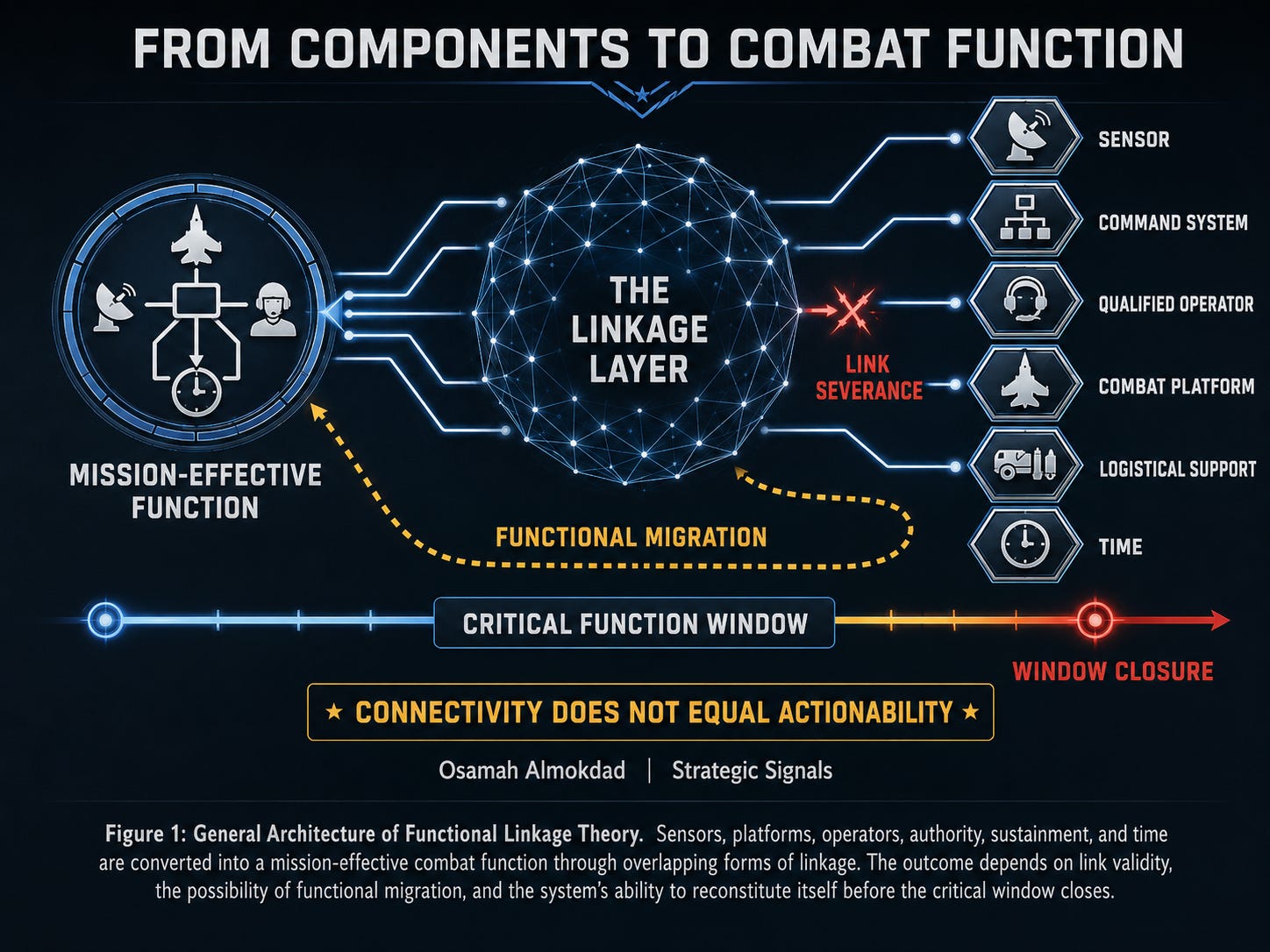
The Linkage Layer: The Distance Between Components and Action
Between a military component and its combat effect lies a layer that is rarely visible in overhead imagery, yet gives the component its meaning: the linkage layer.
It is not one communications network or a single chain of command. It is the architecture through which dispersed components are assembled into an executable function.
Six principal operational forms of linkage can be distinguished.
Informational linkage moves detection, identification, target tracks, targeting data, unit status, and engagement results to the elements that require them. A sensor that can see but cannot transmit what it sees does not complete a combat function.
Command linkage connects information to authority. It determines who decides, what authority has been delegated, which constraints govern the decision, and how long the order takes to become action. A system may possess an accurate picture and a capable weapon yet fail because authorization arrives after the engagement window has closed.
Temporal linkage synchronizes the elements that must be present at the same moment. The sensor, weapon, operator, and decision may each be available independently, but their failure to converge in time prevents the engagement from being produced.
Logistical linkage makes the function repeatable. Fuel, ammunition, transport, spare parts, repair, technical evacuation, and specialist support connect one sortie to the next, one firing to the next, and one salvo to the next. Without them, a force may produce a successful event—but not a sustainable capability.
Human and doctrinal linkage resides in operators, experience, trust, procedures, certification, shared professional language, and judgment acquired through training. Machines may exchange data while the institution remains unable to convert that exchange into coordinated action.
Spatial linkage places sensors, firing units, transport assets, and command elements within an operational geometry in which ranges and sectors of responsibility overlap in a usable manner. Deployment is not merely distribution across a map. It is the design of relationships within space.
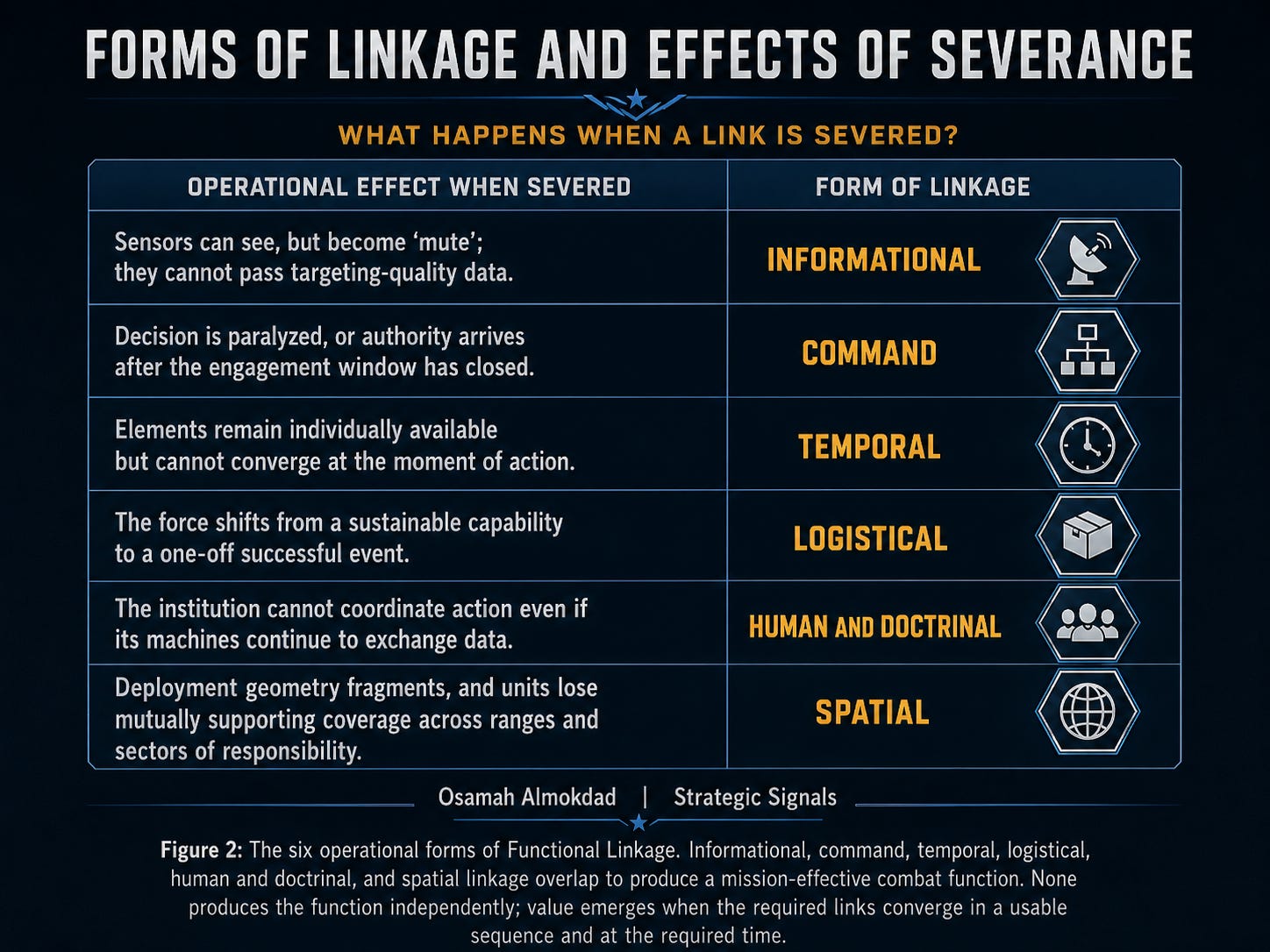
These forms do not operate independently. They overlap to produce what may be called a mission-effective function: a composite performance that meets the required threshold for a specific mission, in a specific theater, while that performance is still capable of changing the outcome.
Regenerative linkage, which this study examines later, is not a seventh operational form at the same analytical level. It is a second-order relationship connecting the current function to the institution’s capacity to reproduce the personnel, expertise, qualification, and procedures required to generate it again in the future.
Combat power, in this sense, does not reside within components individually. It emerges when they are linked correctly, in the correct sequence, and at the correct time.
Link Validity: Connectivity Does Not Equal Actionability
A link is not binary—present or severed.
A communications channel may remain open. Data may continue to flow. Systems may exchange messages. Yet the link may still be incapable of producing combat effect.
The integrity of a link is not measured by signal passage alone. It is measured by its ability to convert what passes through it into mission-effective action.
Link validity can be tested through five cumulative conditions.
Physical availability: A functioning path must exist to carry the required information, order, or sustainment with sufficient capacity, reliability, and security. The nominal existence of a channel is insufficient if it is intermittent, saturated, insecure, or incompatible with the systems that depend upon it.
Semantic compatibility: Connected elements must interpret the data according to the same operational meaning and standard. Systems may exchange messages technically while disagreeing about identity, priority, track status, or the meaning of a warning.
Epistemic confidence: Information must be considered sufficiently accurate and trustworthy to support a decision. A track received without reliable identity or acceptable classification does not become a valid combat input.
Command authority: The receiving entity must possess the authority, delegation, rules of engagement, and organizational permission required to convert information into an order and an action. A system may detect and classify the target yet remain unable to act because nobody is authorized to do so.
Temporal validity: Information transfer, verification, decision, and execution must be completed before the window for action closes. A link that functions after the deadline may be technically intact but operationally worthless.
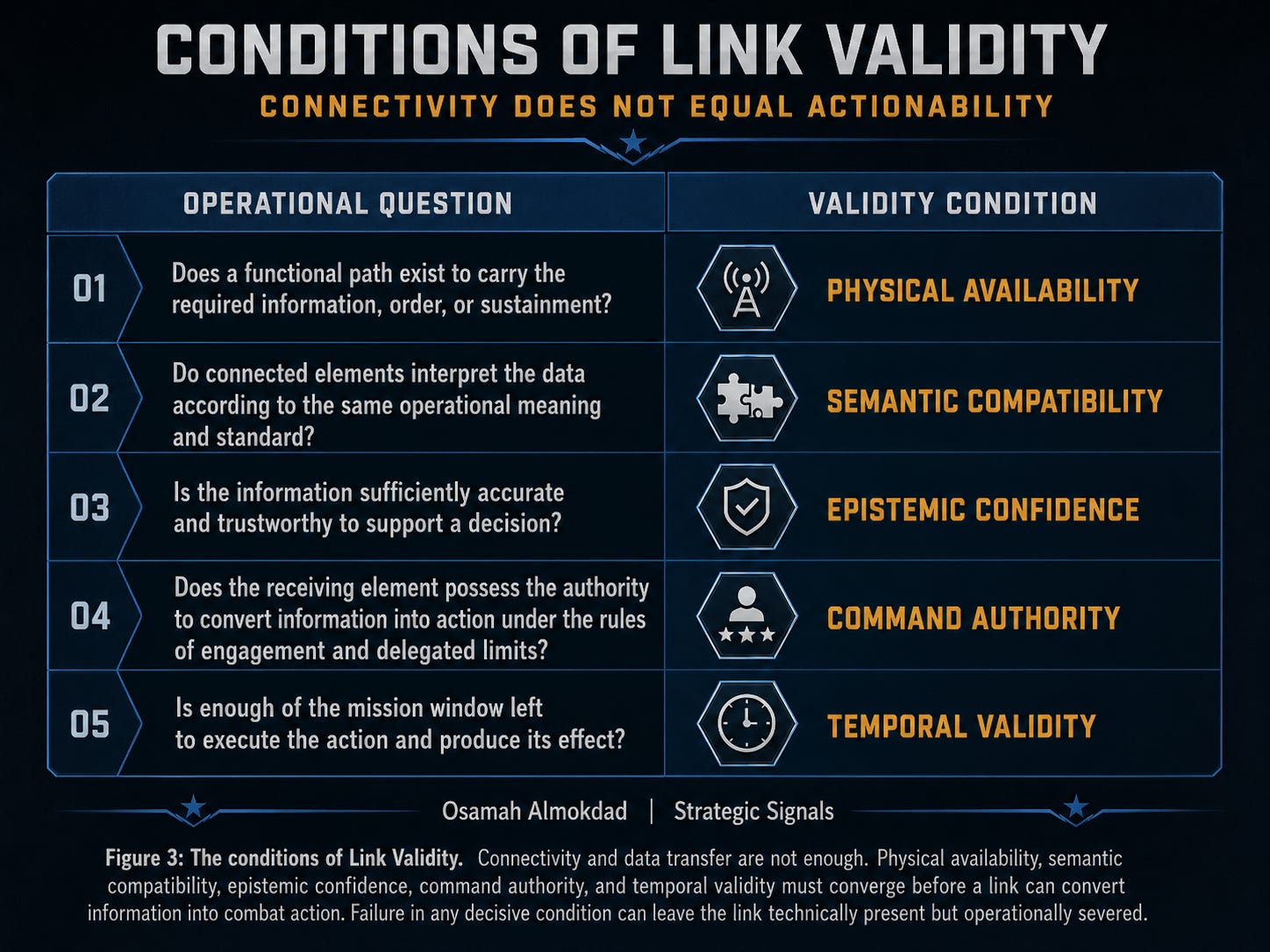
These conditions are not additional forms of linkage alongside the six operational forms. They are tests through which informational, command, temporal, human, and other links must pass before they become productive.
An air track may reach a firing unit but fail to produce an engagement because its classification remains uncertain. Identity may be trusted, but authority may not have been delegated. Authorization may be valid, yet arrive after the target has left weapon conditions or the engagement window has closed.
In integrated air defense, for example, the function does not arise from detection alone. Detection must be transformed into a coherent track, then into trusted identity, then threat classification, then an authorized decision, then weapon assignment and engagement at the required time.
Every component may function technically while the chain fails at confidence, authority, or time.
A link that transmits data but does not make that data operationally admissible as a basis for decision is technically present—and operationally severed.
The value of a link therefore derives not only from the elements it connects, but from the validity it gives to the flow of information, authority, and sustainment until that flow becomes action.
A Target Does Not Have One Set of Coordinates
Targeting begins by describing the target. It fails when that description ends with the target’s physical identity.
A target occupies four positions that must be distinguished.
Geographic position indicates where it is: its coordinates, terrain, range, protection, mobility, and accessibility.
Functional position indicates where it sits within the assembly of combat power: What does it receive? What does it transform? What does it authorize? Which elements depend upon it? Which pathways can bypass it?
Temporal position indicates when its absence becomes consequential: When is it active? When is it exposed? During which phase does the system depend upon it? When does the function it serves lose its relevance?
Regenerative position indicates its role in reproducing future capability: Does it train operators? Preserve specialist knowledge? Grant qualification or certification? Return disabled equipment to the operational cycle? Can the institution replace it internally?
These positions are not identical.
A large headquarters may be geographically prominent but functionally marginal because authority has already been delegated.
A small data relay node may possess limited physical value yet serve as the only bridge between a sensor and a firing unit during a particular phase.
A radar may be important in general, but become decisive only during the minutes in which a strike package passes through its coverage toward a protected target.
A training center may be far from the immediate fighting, yet contain the capacity of an entire arm to survive beyond the current generation of operators.
Coordinates tell us where a target is.
Its functional position explains why it matters.
Its temporal position determines when its loss becomes decisive.
Its regenerative position reveals whether the damage will end in the present—or travel into the system’s future.
A target therefore possesses several forms of value:
Intrinsic value, derived from what it is.
Functional value, derived from what it performs.
Linkage value, derived from the elements and functions it connects.
Temporal value, derived from the moment at which it is required.
Regenerative value, derived from its role in producing future capability.
Target priority should not follow size, price, or visibility alone. It should follow the interaction of these values with the required function, mission, and time window.
Target priority is therefore not a fixed quality inherent in the target.
It rises when the target occupies a central position in producing the function, alternatives are scarce, functional reconstitution after its loss will take time, its absence intersects with a critical window, or its effect extends into the system’s regenerative capacity.
Priority falls when the target can be bypassed quickly, regardless of how visually prominent it is or how expensive it appears in an inventory.
Component value describes what will be destroyed. Linkage value describes what will stop because it was destroyed.
Contemporary military doctrine already distinguishes between high-value targets for the adversary and high-payoff targets for a friendly course of action.
Functional Linkage Analysis adds a more precise question:
Which specific function will fail if this target is lost? Through which links? For how long? And can the adversary assemble the function somewhere else before the effect loses its value?
The Limits of Visibility: A Linkage Map Is Not a Map of Certainty
The linkage layer does not appear on the battlefield with the same clarity as installations and platforms.
A building, antenna, aircraft, or radar battalion can be observed. But the relationship of trust between two institutions, the actual limits of delegated authority, an alternate data pathway, the concentration of scarce expertise, or the rules governing transition to an alternative operating mode may appear only when activated.
Some may never appear except through their effects.
Analysis must therefore distinguish among three things:
The real architecture through which the adversary operates.
The intelligence picture constructed of that architecture.
The architecture the adversary deliberately chooses to reveal.
The most visible pathway may not be the most important. A node that appears central may be an analytical decoy, while the decisive alternative remains dormant until the strike occurs.
A link should therefore not be described as critical without also describing the level of confidence in its existence and role.
A link may be:
Confirmed by multiple sources.
Assessed as likely through converging but incomplete indicators.
Inferred because the structure of the function requires it, though it has not yet been observed.
Unknown because available knowledge is insufficient to support judgment.
These are not marginal intelligence footnotes. They are part of the validity of the judgment itself.
High centrality assessed with low confidence is not equivalent to the same centrality demonstrated through observation and testing.
Uncertainty does not invalidate analysis. Its purpose is to convert the map into a set of hypotheses that can be tested and updated.
Surveillance may reveal synchronization among dispersed elements. Behavioral change may expose a transfer of authority. The return of a function after disruption may reveal an alternative route that was previously unknown.
Operational results thereby become an input for reconstructing the linkage map—not merely the conclusion of strike assessment.
Functional Linkage Theory does not require a complete map. It requires that we do not confuse the system’s architecture with our knowledge of that architecture.
Four Outcomes That Must Not Be Confused
Strike language often compresses several distinct outcomes into a single word: destruction.
This is one of the principal sources of analytical distortion.
Four outcomes must be separated.
Target destruction: Physical damage to an entity or removal from its original condition.
Functional disruption: Partial or total reduction or suspension of the performance associated with that entity.
Link severance: Separation of the elements that must cooperate to produce the function, whether those elements remain physically intact or not.
Denial of reconstitution: Preventing the adversary from restoring the function through repair, replacement, rerouting, delegated authority, or reorganization.
These are not guaranteed steps on a single ladder.
A target may be destroyed without disrupting the function because an alternative is ready or because the role was transferred before the strike.
Severing a limited link may generate cascading effects across the system without substantial physical destruction.
Disabling a power or cooling circuit upon which a radar battalion’s processing node depends, for example, may stop data flow, degrade the recognized air picture, and delay decision-making.
The scale of effect is not an extension of the physical size of what was destroyed. It derives from the component’s position in the chain of dependence.
A brief disruption may be decisive when imposed at the correct moment.
Denial of reconstitution may also be achieved without an additional strike when the missing element is time, confidence, professional certification, or an operator base that cannot be regenerated during the war.
The essential difference is between destroying what the adversary possesses and preventing what it possesses from becoming action.
The component may be destroyed while the relationship survives. If the relationship survives, the function may migrate to another component.
This is why many strikes hit their targets without achieving their purpose.
They engage the components—not the logic that assembles them.
The Critical Function Window
Functional attrition established that time is part of capability—and that a response arriving after the opportunity may be equivalent to absence.
But that was a judgment concerning output.
Functional Linkage Analysis moves time inside the architecture of the function itself:
How long must the links between detection, decision, and execution remain assembled for the function to retain meaning?
Recovery is usually measured by a technical clock:
How long is required to repair equipment, restore software, change frequency, or restore radar emissions?
The battle operates by another clock:
the clock of opportunity.
Consider a central radar disrupted, deceived, or jammed during the approach of strike aircraft, bombers, or an airborne assault force.
The radar may return after a period. Its operators may recalibrate it, restore communications, rebuild and verify tracks, and reintegrate it into the detection, warning, and engagement architecture.
Technically, the radar has returned to operation.
But what if the aircraft have already crossed the decisive detection zone, delivered their strikes, inserted a force that seized a position, disabled a critical installation, or captured key leaders?
The restored radar cannot restore the opportunity it existed to protect.
The function has returned after the mission that gave it value has already ended.
The disruption was temporary.
The result may be irreversible.
Here, the critical function window becomes more than a deadline for measuring output. It becomes a condition of link validity itself.
It is the period during which the function must remain available to fulfill its purpose in a specific mission.
If reconstitution is completed before the window closes, part of the mission may still be recovered. If it is completed afterward, the system may return to technical operation without regaining its value against the event it was designed to prevent.
This condition constitutes a temporal mission kill.
It does not require permanent destruction.
It requires keeping the function absent until its relevance to the mission expires.
Five minutes of blindness during penetration may be more valuable than twelve hours of blindness after the strike is complete.
The severity of disruption must therefore be measured not only by duration, but by what became possible during the absence—and by whether those consequences can be reversed after the system returns.
The function may recover. The opportunity does not.
Time is not merely a condition surrounding the target. It is part of the target’s value.
Success does not necessarily mean keeping a system out of operation for the longest possible period. It means keeping the system outside the function during the period in which its absence equals an operational result.
Repair Is Not Reconstitution
Functional attrition placed recovery within the calculation of capability.
Functional Linkage Theory breaks what is commonly called “recovery” into three operations that should not be compressed into a single timeline:
Repairing the component.
Reintegrating the component.
Reconstituting the function.
Repair returns the component.
Reintegration restores its position within the system.
Reconstitution restores the combat function.
A radar may be repaired at component level yet still require calibration, secure connectivity, data verification, track reconstruction, and reintegration into command and control before it resumes its air-defense role.
An aircraft may be technically serviceable yet unavailable for combat because weapons configuration, mission data, ground support, or a qualified operator is missing.
A command center may resume transmission while subordinate units have lost confidence in the operational picture it provides.
The reverse is also true:
The function may return without repair of the original component.
The adversary may substitute another sensor, move communications to another network, delegate engagement authority, reorder the operational cycle, use an external data source, or accept degraded performance that is nevertheless sufficient.
In self-healing systems, the link is not always an established channel that can first be observed and then severed.
Three conditions should be distinguished:
An active link carrying the function now.
A latent link prepared in advance to replace it.
A relinking rule base capable of generating a new pathway after disruption.
That rule base may consist of a protocol that reroutes data, predelegated authority that moves decisions downward, autonomous logic that allows a platform to continue after communications loss, or local rules enabling distributed elements to reorganize themselves.
Even a highly decentralized system does not operate without links.
It shifts part of the linkage from the time of execution to the time of design, training, and programming.
Commander’s intent, identification rules, classification models, trust keys, synchronization, and team-formation logic are all relationships planted before engagement. They remain present even when the direct command link disappears.
Autonomy is not the absence of linkage. It is the relocation of linkage from exchanged orders during execution to rules embedded before execution.
Not every repair restores the function.
Not every restoration of function requires repair.
The more accurate measure is functional reconstitution time: the period extending from disruption until a specified level of mission-effective output has been restored.
It is insufficient to say that the function has “returned.”
Its speed, accuracy, capacity, repeatability, cost, signature, and ability to survive another attack cycle must also be assessed.
If the system returns at forty percent capacity, with a longer decision cycle, greater dependence on one link, and a higher electromagnetic signature, it has not returned to its previous condition.
It has assembled a new linkage architecture.
That architecture may produce the function now—but it carries its own vulnerabilities.
The true competition is therefore not between the speed of destruction and the speed of repair. That formulation remains at the surface of the problem.
The deeper competition is:
Between the speed at which links are severed and the speed at which they are rebuilt—and between the attacker’s ability to keep the function disassembled and the defender’s ability to reassemble it before its window closes.
Rapid repair may support rebuilding, but it is not equivalent to rebuilding.
Repair may be delayed while functional reconstitution arrives first through an alternative route.
The decisive condition is not the state of the component.
It is the state of the function at the required time.
Functional Migration: Where Does Capability Go After Severance?
Severing a link does not determine the outcome unless analysis understands what the function does next.
The function does not always remain in place awaiting repair. It may migrate to another assembly of elements, authorities, and pathways.
It may move from central command to delegated decision-making; from a primary sensor to distributed sources; from a high-capacity network to slower communications; or from precise specialist operation to a lower-performance mode that is nevertheless sufficient to continue the mission.
Functional migration is broader than communications rerouting.
It is the relocation of the function’s center of production—and with it, the relocation of dependence and vulnerability.
What returns after severance may retain the same name, yet no longer operate through the same architecture, at the same capacity, or with the same risk.
Analysis must therefore follow six questions:
What event triggers migration?
To which architecture does the function move?
How long does the transition take?
How much performance migrates with it?
Which new dependencies and signatures arise in the alternative architecture?
How long can the temporary architecture survive or reproduce itself?
The roles of fighting spirit, cohesion, discipline, and initiative belong here.
They do not replace lost fuel. They do not manufacture targeting data that does not exist. They do not grant an operator a qualification never acquired.
But they influence the likelihood of inventing an alternative link, the speed of transition, and the ability to accept degraded performance while continuing to fight.
They should therefore be treated as modifiers of reconstitution and functional migration—not as independent technical links or magical substitutes for materiel requirements.
Every strike against a linkage architecture is also a wager on where the function will go next.
If the attacker concentrates only on the active link without understanding the logic of migration, it may drive the function into a less visible and more resilient architecture.
If the defender designs alternatives without estimating transition time and performance thresholds, it may discover that its backup route is incapable of supporting the mission it was meant to protect.
A linkage map is therefore incomplete if it identifies only the point of severance.
It must also include the possible routes of functional migration and the vulnerabilities that will arise at each destination.
Asymmetry: When Linkage Flexibility Compensates for Materiel Scarcity
Functional Linkage Theory helps explain why a force with technological and firepower superiority may fail to convert that superiority into decisive effect against an adversary with fewer assets.
The weaker actor may not compete in the number or price of platforms. It may compensate through low-cost, distributed, substitutable links that can be rebuilt rapidly:
Delegated tactical decisions, multiple communications methods, small cells, dispersed stockpiles, and human knowledge capable of moving between different tools.
While the conventional force strikes the most visible components, the function may already have migrated to another assembly—less efficient, but still sufficient to continue fighting.
Asymmetry should not be reduced to the image of a conventional military facing a nonstate force.
It may exist within a particular function during interstate war when an expensive system that is slow to relink confronts a cheap tool capable of rapid substitution—as in the competition between drones and the means used to defeat them.
The experience of contemporary wars reinforces the same principle across different actors and contexts:
Tunnels, drones, mines, and cell-based dispersion derive their strength not from the objects alone, but from the actor’s ability to reconnect information, decision, and action after each strike.
This does not mean asymmetric architectures cannot be broken.
It means their center of gravity may be less visible than their tools.
The problem is not always that the superior force failed to destroy enough. It may be destroying components of high nominal value while the adversary rebuilds the relationship at lower cost and in less time.
The equation of superiority is then reversed:
The stronger actor may win the exchange of physical losses while losing the competition to reconstitute the function.
Functions That Reproduce Functions
Functional attrition addressed regeneration as a force’s ability to restore its output.
Functional Linkage Analysis asks about the architecture that produces those responsible for generating the output:
Who qualifies them? Who tests them? Who certifies them? Who holds the knowledge that manuals alone cannot transmit?
Some links assemble combat power for use now.
Others reproduce the capacity to assemble it tomorrow.
This is regenerative linkage.
Training centers, specialist schools, instructor operators, conversion units, testing and certification authorities, and repositories of technical knowledge do not ordinarily execute direct engagements.
But they produce the personnel, expertise, and procedures that make future engagements possible.
Their value does not lie in today’s sortie.
It lies in preventing today’s sortie from becoming the last one the system can generate through its own institutional capacity.
An entire formation—or even an entire weapon type within a particular institution—may therefore leave effective service without all of its platforms being destroyed.
The case of the sole MiG-23BN squadron in the Syrian Air Force provides a revealing example based on the author’s direct professional experience.
In late 2021, during an extended professional discussion, the colonel who had commanded the squadron explained how the type had effectively ceased flying—not because a single strike had destroyed all of its aircraft, but because the human and institutional chain required to operate and regenerate the capability had collapsed.
There were no longer enough qualified pilots capable of executing combat missions.
There was no adequate depth of assistant pilots or pilots under training to provide replacement and succession.
There were no instructor pilots capable of producing a new cohort.
This deficit interacted with poor administrative decisions, corruption, favoritism, and the mismanagement of resources and expertise until the surviving aircraft gradually shifted from combat platforms into assets incapable of generating combat power.
The type did not disappear from records and airfields in one destructive event.
It ceased to be an effective combat capability when the chain that converted an aircraft into a sortie, the sortie into a mission, and the mission into repeatable capability was severed.
In general terms, an operator base consists of three layers:
Qualified operators produce the current function.
Operators under training provide replacement depth and succession.
Instructor operators reproduce the base itself.
When the first layer erodes, present output declines.
When the second disappears, the force loses its replacement depth.
When the third collapses, the institution loses its internal capacity to reverse the decline.
Platforms may remain in shelters and inventories, but the chain that turns them into combat action has been severed.
A platform without a qualified operator is a logistical burden and a potential target—not combat power.
This is not merely a “personnel shortage” in the narrow administrative sense.
It is the collapse of the operator base.
At its extreme, the weapon type crosses a regenerative extinction threshold: the point beyond which the institution can no longer reproduce the competence required to operate it internally.
The capability can then be saved only by rebuilding the qualification chain or importing that chain from outside.
The damage may not appear immediately.
The remaining operators may preserve the appearance of readiness for a period. But fatigue, retirement, reassignment, medical exclusion, skill decay, and the normal rotation of personnel eventually reveal the gap created when training stopped earlier.
Sortie or fire generation declines today because a cohort was not trained yesterday.
Some targets therefore do not carry the current combat function.
They carry the system’s ability to generate its next function.
That is regenerative value—slower to become visible than an explosion, but potentially far more enduring.
When Battle Damage Assessment Misleads Us
The functional attrition framework introduced an assessment layer that measures declining output:
Can the force still detect, decide, strike, recover, and repeat?
Functional Linkage Analysis goes one level deeper.
It does not merely establish that output declined. It searches for the link that caused the decline—and for the pathway through which the function was restored.
The new assessment question is therefore not:
“Has the target returned?”
Nor is it only:
“Has the function returned?”
It is:
Which linkage architecture returned? Is it the original architecture or an alternative? What changed in its dependencies, speed, visibility, and regenerative capacity?
Modern doctrine is not blind to function. It distinguishes physical from functional damage and considers recovery and system-level effects.
But operational practice, under time pressure and the demand for certainty, tends to privilege what can be counted and photographed:
A destroyed building, burned equipment, a cratered runway, or a confirmed explosion.
The linkage layer is more difficult to observe.
It may be a relationship of trust between institutions, a delegated-authority arrangement, a trusted data path, a rare concentration of expertise, a software dependency, or a sequence visible only when activated.
Its collapse may produce no visible wreckage.
The return of emissions may be misinterpreted as the complete return of function.
Regenerative loss may not become visible for months or years.
Linkage assessment should therefore examine:
Which links were severed, and which remained valid?
Which links were unique, and which could be substituted?
Did the adversary restore the same architecture, or assemble the function through another route?
Did the function return within its critical window or after it had expired?
At what capacity, accuracy, decision speed, cost, and signature did it return?
What became possible during its absence, and can those consequences be reversed?
Did the disruption damage the operator base or regenerative capacity?
Can the restored function survive another targeting cycle?
The answers may reveal four very different realities behind the same strike image:
A physical loss with little functional effect.
Temporary disruption with no sustained consequence.
A short absence that caused an unrecoverable mission failure.
A delayed collapse in regenerative capacity not yet visible in campaign reporting.
Linkage assessment therefore becomes the causal explanation beneath functional attrition assessment—not another version of it.
Wreckage is evidence that the strike occurred.
Reduced output is evidence of its effect.
The linkage map explains how the effect traveled through the system—and how it was contained or deepened.
Functional Linkage Analysis
Functional Linkage Analysis does not replace the functional attrition framework. It follows it.
The first tells us that output has declined and by how much.
The second explains why it declined, where the chain producing it was severed, and how the adversary may reconnect it.
It does not begin with a list of installations.
It begins with a strict definition of the function under examination.
The unit of analysis is not “air defense” or “naval power” in general terms.
It is:
A specified actor performing a specified combat function, in a specified theater, at a specified performance threshold, within a specified time window.
“The ability of a particular formation to detect a penetrating aircraft, classify it, authorize engagement, and intercept it before it reaches a protected installation” is far more useful analytically than a broad category such as “the air-defense system.”
The function is then decomposed into its components, inputs, operators, authorities, links, sequence, sustainment, and timing.
Analysis identifies:
Links with no substitute.
Links that can be replaced.
Links visible only when the function is activated.
Elements that reproduce the capability in the future.
Priority then follows functional centrality, linkage value, temporal sensitivity, depth of alternatives, and reconstitution time—not the size or price of the target alone.
It is not enough to establish that a link exists.
Its physical availability, semantic compatibility, epistemic confidence, command authority, and temporal validity must be tested.
Possible destinations of functional migration are then mapped:
The alternative architecture, the rule base governing transition, the time required to activate it, the performance threshold it can produce, and the new vulnerability it carries.
To prevent the analytical map from becoming false certainty, every link should carry two linked profiles.
The operational profile describes its necessity to the function, alternatives, temporal sensitivity, and regenerative role.
The epistemic profile describes confidence in the judgment, the source of inference, indicators that support or contradict it, and the possibility of a hidden alternative or false centrality deliberately created by the adversary.
These variables should not be compressed into a magical number.
They should remain visible so that the commander understands the difference between the importance of a link and the strength of the knowledge supporting that judgment.
Functional reconstitution time should not be treated as a single technical clock.
It is a sequence beginning with detection of the break, recognition of its effect, selection of an alternative, creation of the new link, and verification that the function has returned to a mission-effective threshold.
The sum of these periods is compared with the time remaining in the critical window.
If it exceeds that time, the mission has been temporally killed—even if the system returns later.
At the foundational level, ordinal estimates and probability ranges are sufficient:
A link with no alternative, limited alternatives, or multiple alternatives.
High, medium, or low confidence.
Reconstitution that precedes, competes with, or exceeds the critical window.
Converting these assessments into numerical weights, simulations, or decision-support algorithms would require field data and repeated testing.
The number is the result of documented judgment—not a substitute for it.
The adversary’s response must then be incorporated into the analysis rather than limiting analysis to the first-order effect of the strike.
Can the adversary delegate authority?
Reroute information?
Replace the operator?
Perform the function at a lower standard?
Use an external detection source?
Wait for repair?
Where can the function migrate, and at what level of performance?
Will the mission window close first?
Can the human base replace what was lost—or is the capability declining without an heir?
Finally, Functional Linkage Analysis does not repeat the measurement of output already conducted by the functional attrition framework.
It maps the production, disruption, and reconstitution of that output.
It identifies the link that carried the strike effect, the architecture that restored the function, and the new vulnerabilities created by that restoration.
Functional Linkage Analysis does not replace operational judgment, intelligence validation, appropriate weapon and munition selection, or legal review.
Functional centrality does not, by itself, make an object a lawful target.
Distinction, proportionality, precautions, rules of engagement, and command authority remain independent and indispensable requirements.
What Is New Here?
The importance of nodes, links, critical requirements, and target-system analysis is not a new discovery.
Contemporary U.S. doctrine already addresses the physical, functional, and temporal characteristics of targets. It distinguishes physical damage from functional damage and considers system effects and the time required to restore function.
NATO doctrine distinguishes between targets of high value to the adversary and targets of high payoff to a friendly course of action.
Network approaches examine relationships.
Kill-chain models divide combat action into detection, decision, engagement, and assessment.
A major strand of Chinese operational thought centers on systems-destruction warfare, which views war as a confrontation between interconnected operational systems rather than merely an exchange of destruction between forces and platforms.
In relation to functional attrition, the distinction is between outcome and mechanism.
Functional attrition describes the decline in a force’s ability to produce action with what remains.
Functional Linkage Theory decomposes the architecture that turns what remains into action—and then explains how that architecture is disrupted and reassembled.
The first measures loss in function.
The second reveals the architecture through which the function is created.
Functional Linkage Theory therefore does not claim to have discovered that military systems are interconnected.
Its proposed contribution lies elsewhere.
It makes the dynamic assembly of a mission-effective function the central object of analysis, bringing together five questions often examined separately:
How do dispersed components and operators become a combat function?
When is a link capable of producing action rather than merely providing connectivity?
When does the function acquire value, and when does its relevance to the mission expire?
How does the adversary reassemble it after disruption, where does it migrate, and which rules generate alternative links?
How does the system reproduce the operators and expertise required to generate the function in the future?
The study thereby moves from the importance of a network in a static state to the production of function under changing conditions.
No link is critical in the abstract.
A link becomes critical when a specified function depends upon it, alternatives are insufficient, and the mission requires that function before a deadline that will not wait.
The order of battle shows what exists. Functional attrition shows how much output remains. The functional linkage map reveals how that output was created, where it can be severed, and through which architecture it may return.
Strategic Judgment
The deepest error in target-centric warfare is the assumption that a sufficient quantity of destruction will eventually aggregate into defeat.
It may.
But destruction and defeat belong to different analytical categories.
Destruction happens to objects.
Defeat begins when the adversary can no longer assemble the functions required to continue, adapt, or recover in time.
This explains how a radar may return after the moment for which it existed has passed.
How a small node may exceed the value of a large headquarters.
How a communications pathway may remain open while losing its eligibility to produce an engagement.
How brief disruption may generate an irreversible outcome.
How a function may migrate to a new architecture without repair of its original component.
And how a weapon type may disappear from effective service because the institution can no longer reproduce its operators.
It also redefines resilience.
Resilience is not the survival of components.
It is the system’s ability to preserve a mission-effective function—or reassemble it under pressure before the critical window closes—and then regenerate the operators and resources required to produce it again.
The battlefield may resemble a puzzle whose pieces are scattered across domains, organizations, frequencies, databases, authorities, and human expertise.
But the analytical objective is not to break the greatest number of pieces.
It is to identify which pieces hold the picture together, when the picture must be complete, and whether the adversary can reassemble it after it is broken.
A strike campaign fails when it destroys the adversary’s components faster than it understands how the adversary reassembles them.
Military power is assembled in time.
It lives in platforms, but it also lives in links, authority, trust, training, sustainment, and the shrinking distance between detection and decision.
Breaking a system therefore means more than destroying its components.
It means preventing those components from becoming a function when the battle requires it.
In adaptive systems, severing the existing pathway is not enough.
Analysis must explain the adversary’s ability to generate another—and determine whether relinking will beat the deadline or arrive after it.
Doctrinal and Technical References for Comparison
U.S. Air Force, AFDP 3-60: Targeting, May 1, 2026.
U.S. Air Force, AFDP 3-0.1: Command and Control.
U.S. Joint Chiefs of Staff, JP 3-60: Joint Targeting, September 28, 2018.
NATO, AJP-3.9: Allied Joint Doctrine for Joint Targeting, Edition B, Version 1, November 2021.
U.S. Department of Defense, Military and Security Developments Involving the People’s Republic of China 2024, December 18, 2024.
Bradford Witt and Sorin Matei, Mission Modeling for Commanders: Improved Operational Effectiveness through the Use of Measurable Proxy Variables, Military Review, March–April 2023.
Defense Advanced Research Projects Agency, Edge-Directed Cyber Technologies for Reliable Mission Communication — EdgeCT.
Defense Advanced Research Projects Agency, Mission-Integrated Network Control — MINC.
Defense Advanced Research Projects Agency, Rapid Experimental Missionized Autonomy — REMA, February 8, 2024.
Defense Advanced Research Projects Agency, Decentralized Artificial Intelligence through Controlled Emergence — DICE, June 10, 2026.
NATO, NATO Integrated Air and Missile Defence Policy, February 13, 2025.
Joshua Urness, IBCS Paradigm Shifts: Decoupling Components and Crews, Air Defense Artillery Journal, November 1, 2024.
Methodological note: The references above establish the doctrinal and technical ground with which this study engages. They are not cited to suggest that “Functional Linkage Theory” is an adopted concept within those documents. The theory and its terminology constitute an analytical framework proposed by the author.
Author’s note: The MiG-23BN squadron case is based on direct professional experience and on a detailed discussion conducted by the author in late 2021 with the colonel who had commanded the sole squadron operating the type within the Syrian Air Force. It is presented as professional testimony and operational observation, not as an event drawn from a published official record.
Arabic edition: Read the Arabic version on Conflict Engineering
© 2026 Osamah Almokdad / Strategic Signals. All rights reserved. No part of this publication may be copied, quoted, translated, adapted, republished, distributed, or incorporated, in whole or in part, into any commercial, academic, media, or training product, used in the training of artificial-intelligence systems, or used to produce derivative works without the author’s prior written permission, except where expressly permitted by law.
Permission requests: legal@osamahalmokdad.com

After reading this article, I find myself in front of a work that deserves pause and deep reflection. Not only does it provide new information, but it rearranges our analytical priorities in a way that makes us see what we were overlooking.
What really impressed me
Moving from "what" to "how" – As long as our military analysis focuses on measuring losses and estimating damages, this is of course necessary, but the article takes us a step further: to understand how combat capability is produced in the first place, where it can be interrupted, and how the adversary reassembles it. This is a fundamental shift in the angle of view.
The Distinction Between Destruction and Defeat – Perhaps More