

Siege Engineering
When Siege Moves Beyond Space, Enters Time, and Besieges the Future


In its earliest form, siege was a visible act that required little interpretation: sealed walls, severed roads, soldiers encircling a city, and supplies diminishing with each passing day. Space was the object of the siege, and the distance between besieger and besieged was measured by the reach of the arrow, the cannon, the catapult, and the road.
In the contemporary world, however, borders may remain open, aircraft may continue to fly, and stores may remain full—and yet a state may still be under siege. Not because it lacks resources, but because it cannot convert what it possesses into utility, what it produces into autonomy, what it knows into technology, or what it accumulates in wealth into status.
Siege has moved beyond the walls and into the functions themselves.
Modern siege does not encircle what a state possesses; it encircles what a state is capable of becoming.
This argument does not claim to have discovered economic sanctions, political isolation, military access denial, or the use of financial and technological networks as instruments of coercion. Each of these already has an established literature. The proposed contribution lies instead in bringing disparate instruments into a single framework that treats the world available to an entity, its capability cycle, and its possible future as the central unit of analysis.
The decisive question is therefore no longer merely: What has been denied to the state?
It is:
What remains available to it? What can it convert into effect? And what is the highest position it can attain within the existing system of constraints?
From Pressure to Siege
Not every form of pressure constitutes a siege. One state may pressure another to alter a specific decision, and that pressure may end once its immediate purpose disappears. Siege begins when the objective moves beyond influencing a particular decision and becomes the sustained control of the space within which the target can live, operate, and develop.
Pressure says: Do not do this.
Siege reshapes the list of things the target is able to do at all.
It does not merely prevent a decision. It reduces the number of available alternatives, raises the cost of some, and makes others conditional on external will. Access is thereby transformed from an autonomous capacity into a privilege that can be granted, withdrawn, or priced.
On that basis, Siege Engineering may be defined as:
The design and management of a graduated system for controlling a targeted entity’s access to the conditions of life, capability, renewal, and status by shrinking its available domain, disabling selected stages of its capability cycle, and holding it between the thresholds of recovery and collapse until a settlement that serves the besieger’s interests becomes less costly to the target than continued resistance.
Yet this definition requires a methodological boundary, lest it expand to encompass every form of weakness, dependence, or domestic failure.
Not every dependence on the outside world is a siege, just as not every weak state is a besieged state. Industrial deficiency, corruption, or poor governance is not enough, by itself, to justify the term.
The condition becomes siege-like when dependence becomes controllable: when the existing structure gives another actor a sustained ability to narrow alternatives, disable a link in the capability cycle, control the terms of access, raise the cost of autonomy, or impose a ceiling on how far recovery can proceed.
Dependence becomes siege when it is no longer merely a need for another actor, but a need through which that actor possesses a key it can close—or price the opening of.
This distinction is essential because it separates weakness generated internally from weakness that becomes externally exploitable. The two may coexist, as they often do, but the presence of one does not automatically prove the other.
The methodological question, therefore, is not merely: Is the state dependent?
It is:
Who holds the key to that dependence, and can that key be used to alter the state’s available choices or prevent it from restoring its capabilities?
Siege, in this sense, is not merely the interruption of flows. It is control over access, timing, alternatives, compensatory capacity, and the conditions under which the gate is reopened.
The most sophisticated siege does not always deny access; it turns access into a privilege that can be granted, withdrawn, and priced.
The Civilizational Law of Siege
Every era has its governing necessities. What a state does not need today cannot serve as an effective instrument of siege against it, no matter how valuable that resource may have been in another age.
Ancient cities depended on water, grain, and roads. Industrial states required coal, oil, ports, and machinery. Contemporary states require, in addition, data, computing power, software, finance, insurance, technical standards, and precise positioning, navigation, and timing services derived from satellites and atomic clocks.
Precise space-based timing signals, for example, do not serve navigation alone. They support telecommunications, electricity systems, financial markets, and other infrastructure. Civilizational dependence itself therefore becomes a potential site of pressure when alternatives have not been built.
Every advance expands human capability, but it also adds another condition that must be maintained for that capability to endure.
Civilizational gains often pass through four stages:
An optional advantage, then a widespread habit, then a necessary function, then an exploitable dependence.
Every civilizational gain begins as an advantage, becomes a habit, then turns into a dependence—and at that point enters the map of siege.
This produces what may be called the paradox of gain: every new capability adds power, yet also adds burdens of maintenance, renewal, dependence, and protection.
Advanced technology does not make a state weak. It does, however, require the construction of alternative systems commensurate with the expanding range of functions that technology supports. The greater the degree of specialization and interconnection, the more a small node can disable functions far larger than itself.
This gives rise to the siege of advanced dependence: the use of systemic complexity, specialization, and interconnection against the system’s owner, so that the problem is no longer merely the loss of one resource, but the number of functions that collapse with it.
Strategic Value Is Temporal, Not Permanent
No material is inherently strategic for all time. The importance of stone, iron, spices, coal, oil, semiconductors, and data changes with the functions on which each era depends.
The strategic weight of a resource should therefore be measured not by scarcity alone, but by four factors:
The number of functions that depend on it.
The difficulty of replacing it.
The speed with which harm appears when it is lost.
The controlling actor’s ability to sustain denial.
The governing resource of an era is the one whose absence can disable the greatest number of functions in the shortest time, with the fewest available substitutes.
A resource may exist inside a state and yet its utility may still be besieged. Possessing oil is not the same as being able to sell it. Possessing minerals is not the same as being able to process them. Possessing talent is not the same as possessing laboratories. Possessing weapons is not the same as being able to operate, maintain, and modernize them.
This leads to one of the central pillars of the theory: conversion siege.
Conversion Siege: From Food to Power
A person does not benefit from food merely by possessing it or having it available in a refrigerator. Nor does one benefit from meat, fish, chicken, or fruit simply as named objects—even after eating them. The body benefits from the components it can actually break down, absorb, metabolize, and convert into energy, construction, and renewal: amino acids, sugars, fats, vitamins, and minerals.
Food may be available, yet its owner may be unable to prepare or consume it. It may be eaten, but a disorder of digestion or absorption may prevent its components from reaching the body. The nutrients may even be absorbed, only for a metabolic disorder to prevent their conversion into useful energy or tissue.
In all of these cases, the resource exists, but its benefit is blocked.
States are not fundamentally different in functional terms.
Wealth may lie beneath the ground while extraction technology is absent. Oil may be produced while transport, insurance, or receipt of payment is obstructed. Money may exist but be unable to purchase technology. Machinery may arrive, but the knowledge, maintenance systems, or spare parts required to operate and renew it may not.
This is conversion siege: the target is not necessarily deprived of the asset itself, but of the processes that reveal its latent potential and convert it into usable value.
Just as the body is not nourished by what sits in the refrigerator, a state is not empowered by what lies beneath its soil; it is empowered by what it can digest, convert, and metabolize into capability.
The more sophisticated form of deprivation does not always confiscate the resource. It leaves the money in place but obstructs its use. It leaves the factory standing but prevents it from operating. It leaves knowledge available but blocks its application. It leaves wealth underground but closes the route between that wealth and the market.
It is the actualization of potential that produces power. When an entity can convert resources into functions, then develop and renew those functions, its strength and autonomy increase.
Advanced siege therefore targets the link that prevents what exists from becoming capability, capability from developing, and development from accumulating into status.
The most dangerous deprivation is not being prevented from possessing something, but possessing it in full and being prevented from benefiting from it.
Siege does not always confiscate potential; sometimes it leaves potential fully visible to its owner, then prevents it from becoming power.
The Capability Cycle
Resources do not become power directly. They pass through an interconnected cycle:
Access → Conversion → Operation → Renewal → Recovery → Accumulation → Status
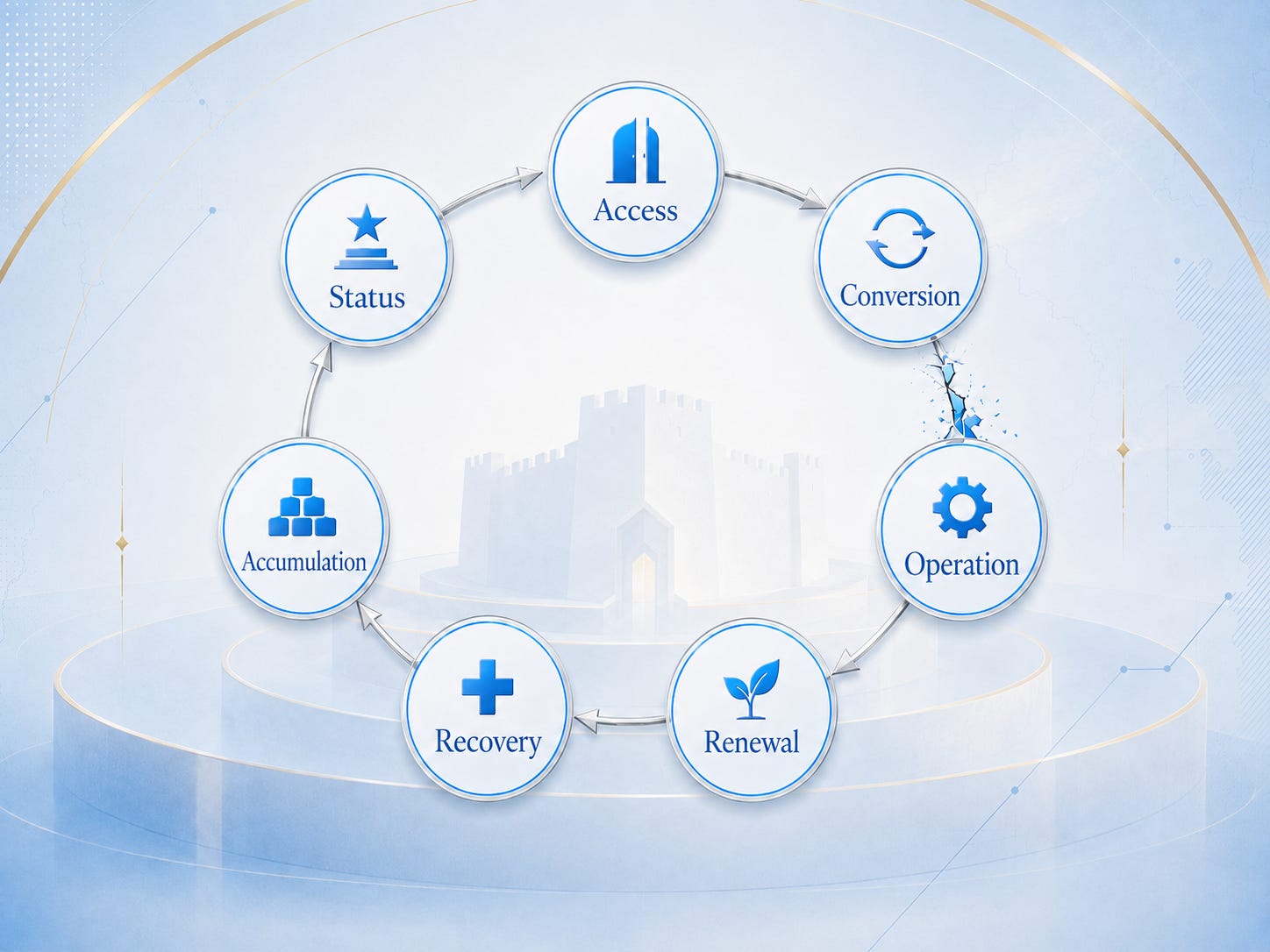
At the access stage, the entity obtains the resource, technology, or knowledge.
At the conversion stage, it transforms what it possesses from a raw state into usable value.
At the operational stage, it uses that value to produce a functioning capability.
At the renewal stage, it replaces what has been consumed, updates what has become obsolete, and trains a successor generation.
At the recovery stage, it rebuilds what was damaged by war or crisis.
At the accumulation stage, it converts isolated achievements into stable capability.
At the status stage, capability becomes autonomy in decision-making and influence over the surrounding environment.
A siege does not need to shut down the entire cycle. It need only close one critical stage.
A state may be permitted to purchase weapons but denied the ability to modernize them. It may receive large revenues but remain unable to transform them into industry. Its institutions may continue functioning, but without the ability to repair themselves or produce the next generation of human and technical capacity.
A state is not powerful because of what it possesses, but because of what it can convert, renew, replace, and develop into cumulative effect.
The Siege Signature
Siege cannot be read from the list of prohibitions alone. What is allowed to pass may reveal the objective more clearly than what is denied.
If consumer goods are allowed while productive machinery is denied, the result is not starvation. It is a society kept consuming without being given the tools of autonomy.
If aid is permitted but investment and reconstruction are obstructed, the result is the prevention of collapse without the permission to recover.
If markets are opened while access to technology and industrial finance is closed, the state becomes an open market without becoming a competitive producer.
If a government is able to finance its daily operations but unable to build long-term institutions, it becomes capable of administering the present while remaining unable to found the future.
The gap between what is permitted and what is denied forms the siege signature.
Siege is not read only through what it prohibits, but through the deliberate difference between what it allows through and what it keeps behind the gate.
From this signature one can infer the deeper objective: Is the purpose to alter a specific behavior? To exhaust capability? To redirect the state? To prevent it from recovering its status? Or to keep it above collapse but below recovery?
Siege of Choice and Direction
A distinction can be made between a siege based on denial and one based on direction.
The first closes doors: no financing, no trade, no technology, no movement, no recognition.
The second does more than close doors. It designs a particular exit: one market instead of another, one alliance instead of another, one payment system instead of another, one elite instead of another, conditional recognition instead of isolation.
It does not merely tell the target where it may not go. It determines the only road the target can still travel.
Negative siege closes the doors; directional siege leaves one door open and ensures that it leads to the desired room.
This produces the siege of choice: the target is not stripped entirely of the capacity to act, but of the alternatives that make autonomous decision-making possible.
Choosing between one door and a wall is not a choice, even if the door remains open.
Signaling Power and Probabilistic Siege
Siege does not always begin with a legal decision. It may be preceded by a statement or signal from an actor possessing credible capacity to act.
A declaration from a major power may delay investment, raise insurance costs, freeze credit, and drive banks and companies away out of fear of what might happen next. Overcompliance and risk avoidance may expand the practical impact of sanctions far beyond what the legal text itself formally requires.
The target thus pays both for what has happened and for what others believe may happen.
This may be called probabilistic siege.
The power of political speech is not measured by the number of words it contains, but by the number of doors that may close because others believed it.
When access becomes unreliable, its cost rises even if it has not been formally severed. The state must increase inventories, immobilize capital, pay higher insurance premiums, and postpone decisions.
This is the siege of certainty: the route remains open, but not reliably enough to serve as a secure foundation for dependence.
One of its most sophisticated forms is intermittent dependency. The target is neither denied the resource entirely, which might force it to learn self-sufficiency, nor granted reliable access on which it can confidently build. It remains suspended between opening and closure, dependent on the gate and fearful that the gate may close.
When Siege Succeeds: Closing the Function
Physical encirclement is not sufficient for siege to succeed, nor must every route be physically sealed. The real objective is to prevent the remaining routes from performing their functions: supply, replacement, retreat, and relief.
This was vividly demonstrated at Yorktown in 1781, when American and French ground pressure combined with maritime control that prevented the besieged British army from receiving effective relief, culminating in surrender in October.
Yorktown shows that successful siege is not measured by the shape of the ring around an opponent, but by its capacity to disrupt the cycle of survival.
Siege is complete when the roads that remain open lose their ability to save those who travel them.
A corridor that does not deliver in time, a resource that cannot be converted, or relief that remains outside the zone of effect does not constitute a meaningful alternative, even if it exists in theory.
When Siege Fails: Berlin and the Alternative Function
What succeeded at Yorktown failed in Berlin nearly two centuries later because physical closure did not become complete functional closure.
In June 1948, roads, railways, and waterways leading to the Western sectors of Berlin were cut. The United States and Britain, however, transformed the air corridors into an airlift for food and fuel, and the operation continued until the land blockade was lifted in May 1949.
The Berlin Blockade did not fail because the encirclement was unreal. It failed because it targeted specific routes without succeeding in monopolizing the function those routes had performed. The ground was closed, but supply was not.
Siege does not succeed by closing the most obvious road; it succeeds by closing the function that road performed.
Time then began to work in the opposite direction. Airlift efficiency improved, the capacity to endure increased, and the political cost to the besieger rose.
This is the siege reversal point: the moment at which continued pressure no longer brings victory closer, but instead becomes recurring evidence of the besieger’s inability to achieve it.
Siege fails when every additional day teaches the besieged how to live without the besieger.
This leads to a broader rule:
Siege is a race between one side’s ability to prevent the future and the other side’s ability to invent an alternative future.
Siege of Renewal and the Future
A siege need not attack today’s power directly. It may allow that power to continue operating until it consumes itself, while denying it the ability to reproduce its replacement.
Machines remain in service, but spare parts do not arrive. Experts remain at their posts, but no successor generation is trained. Institutions continue to operate, but their systems are not updated. Minor damage may be repaired, while the capacity for comprehensive reconstruction remains absent.
This is the siege of renewal.
A siege of renewal does not directly destroy today’s power; it prevents today’s power from producing tomorrow’s power.
When denial extends to the ability to repair what has been destroyed, the siege of recovery emerges. War or catastrophe may create temporary damage, but preventing access to financing, technology, and expertise can turn temporary damage into long-term incapacity.
The depth of a siege is therefore not measured only by the number of facilities that have stopped functioning, but by the number of years—or generations—required to rebuild the capability that has been lost.
The breadth of siege is measured by the number of doors closed; its depth by the number of generations required to reopen them.
Time itself thereby becomes a theater of siege. A restriction that inflicts pain today may be less dangerous than one that prevents tomorrow from repairing today.
Managing the Two Thresholds
The objective is not always to bring about collapse. Total collapse may unleash disorder, migration, arms proliferation, market breakdown, and the rise of actors that are difficult to control.
At the same time, the target’s recovery of strength and return to victory may be unacceptable to the besieger.
Between these two outcomes lie two governing thresholds:
A threshold above which the target regains initiative and recovery.
A threshold below which its collapse becomes more dangerous than its survival.
Siege engineering may therefore seek to hold the entity between them:
Not strong enough to win, and not weak enough for its collapse to become dangerous to its besieger.
It is allowed what prevents collapse and denied what enables recovery. A window of consumption is opened while the windows of production, renewal, and autonomy remain narrow.
This is managed weakness below the threshold.
In its more advanced form, the objective is not to bring the opponent down immediately, but to keep it manageable until conditions mature enough for transition, collapse, or restructuring to become exploitable and controllable.
A profitable siege does not bring the opponent down when it can; it does so when the opponent’s fall becomes exploitable and controllable.
Limited Welfare and Deferred Hope
A system of sustained weakness does not require depriving people of everything. Total deprivation may generate revolt, migration, or dangerous collapse.
A minimum distribution of benefits may be enough:
Salaries, aid, public-sector jobs, modern goods, pockets of personal freedom, and recurring promises of reform.
These benefits may be real and significant in people’s lives. Yet they may also perform a political function: keeping society inside a horizon of hope without enabling the state to restore its deeper capabilities.
A society may be allowed to live better, provided it does not become stronger.
The latest phones and cars may enter the country while no electronics or automotive industry develops. Universities may expand while research remains weak. Money may flow in without becoming production. Markets may open while the keys to finance, technology, and insurance remain outside national control.
Individuals receive some of the fruits of modernity as consumers, while the state does not possess the means of producing those fruits as an autonomous actor.
This gives rise to the siege of deferred hope: the future remains near in rhetoric but distant in reality—a new government, a forthcoming budget, expected investment, reform just around the corner—while waiting itself becomes a mechanism for calming dissent.
The market may become freer than the state, and the consumer’s choices may widen while the country’s choices narrow.
Siege of Reshaping
Some sieges do not end with the fall of the authority under which they began, because the objective may go beyond extracting a temporary concession and extend to reshaping the environment that will produce future decisions.
In classical siege, surrender of the garrison may be enough. In a composite siege, the fall of a ruler may mark only the transition from one phase to another.
The question then becomes:
How much power will the new state be allowed to recover, and who will control the keys to money, security, technology, and recognition after the transition?
Here emerges the siege of reshaping: keeping the entity below the threshold of victory and recovery, but above the threshold of total collapse, until an alternative order becomes executable, financeable, recognizable, and protectable.
Siege does not wait merely for the opponent to fall; it waits for the world after the opponent to become governable.
The process may follow a recognizable sequence: narrowing the field, consuming old alternatives, blocking recovery, allowing a new arrangement to emerge, testing its behavior, and reopening access in proportion to its response.
This can be called forced maturation: raising the cost of remaining within the old order until alternatives once considered unacceptable become less costly than preserving it.
Yet forced maturation carries an enormous risk: the political alternative may mature only after the state itself has been exhausted.
Pressure may succeed in making change possible, while making the state in which that change will occur weaker and far more costly to rescue.
Iraq: Changing the Regime Without Restoring Status
Part of this dilemma is visible in Iraq after 2003. The governing regime changed, a pluralistic political order was established, and large oil revenues flowed into the country. Yet regime change did not automatically produce an alternative national capability commensurate with Iraq’s resources and potential.
This comparison does not imply a preference for authoritarian rule or disregard the wars and disasters produced by the previous leadership. It distinguishes between two different questions:
Did the individual gain greater political and social space?
And did the state recover its ability to convert wealth into production, production into autonomy, and autonomy into coherent regional weight?
According to World Bank estimates for 2025, oil continued to account for roughly 53 percent of Iraq’s real GDP, around 88 percent of government revenue, and more than 90 percent of merchandise exports, while the private sector remained limited in its ability to generate employment.
These figures do not mean that every improvement was illusory. They do, however, reveal the difference between money entering a country and capability being formed within it.
Nor is comparing living standards today with those of two decades ago sufficient, because medicine, communications, transportation, and knowledge have advanced globally. The more revealing test is this: Where did Iraq arrive compared with where it plausibly could have arrived given its resources, population, location, and the same passage of time?
The former Iraq possessed more power than the wisdom of its leadership could responsibly manage; the later Iraq possessed more resources than its institutions could convert into power.
After collapse, regime change, and the transformation of status—and whatever degree of openness and freedom may be presented as the visible price of that transformation—the deeper question remains one that neither markets nor elections alone can answer:
Who will restore to Iraq the meaning of a “great Iraq”—not as a slogan or a threat to its neighbors, but as a state that possesses its decisions, produces its needs, and converts its wealth into knowledge, industry, and status?
Consumption may improve and freedoms may expand while an invisible siege persists in the form of a low ceiling on what the state is able to become.
This brings us to the siege of status.
A siege of status does not target only the decisions of the current government. It limits the degree of power that any future government can recover. Economic structures, security arrangements, and external dependencies become path-locking mechanisms; each new authority inherits the same constraints and incentives.
The highest achievement of siege is not changing the ruler, but changing the ceiling of power that any future ruler can reach.
A citizen may become relatively freer from the grip of a former ruler while the state loses some of its ability to free itself from external constraint.
Not every transition away from authoritarianism is a liberation of the state; the citizen may become relatively freer from the ruler while the state becomes less capable of freeing itself from the outside.
A state’s weakness should therefore be measured not only by what it has lost, but by the distance between what it became and what it could plausibly have become. This distance may be called the possibility gap.
Syria: Transitional Siege and the Repricing of Legitimacy
The Syrian case presents a denser example of composite siege. War produced the fragmentation of the country and multiple zones of control, destruction of productive infrastructure, displacement, financial isolation, sanctions, and a multiplicity of external and domestic powers, each holding a different key to the state.
It would be misleading to reduce this entire trajectory to a single centrally designed plan. More accurately, it combined:
Intentional siege, through declared policies and sanctions.
Resultant siege, produced by war, institutional collapse, and fractured markets.
And exploited siege, in which an existing condition of weakness became useful to multiple actors.
The effect did not fall on the government alone. It struck Syria’s capability cycle: production, finance, energy, transportation, maintenance, trade, and recovery.
The World Bank estimated the cost of rebuilding damaged physical assets at approximately $216 billion—nearly ten times Syria’s projected 2024 GDP. This illustrates why lifting legal restrictions alone cannot restore what years of war and deterioration have consumed.
Here appears the transitional siege: the old order is not permitted to recover its previous strength, the country is not allowed to collapse completely, and external actors wait for the maturation of a new arrangement that can be recognized, financed, and engaged.
When such an arrangement appears, the process moves from besieging the old order to testing the alternative and repricing recognition:
Can it impose a measure of stability?
Will it accept the required commitments?
Will it alter its discourse, structure, and relationships?
Can it become an acceptable channel through which money, borders, and institutions are reopened?
During 2025, substantial portions of broad Western economic sanctions were lifted, while targeted measures related to security, human rights, and the responsibility of specific individuals and entities remained.
Even more revealing was the fact that a legal designation of terrorism that had followed an armed organization for years was later altered after the announced dissolution of the previous organizational structure, the presentation of new commitments, and actions regarded as positive in the emerging relationship with the international system.
This produces a political paradox that should not be ignored:
The past may remain unchanged in the memory of its victims while its legal status changes the moment the interest in recognition becomes greater than the interest in isolation.
A legal designation is not an eternal metaphysical attribute. It is a legal and political classification that can be imposed or removed when the conditions underlying it change, or when the actor’s function, conduct, and position within the emerging order are altered.
In the visible political scene, this transformation is often accompanied by a striking change in presentation: civil names emerge from behind nom de guerres, formal attire replaces combat appearance, rhetoric moderates, language changes, reception venues change, and the player is presented differently to both domestic and international audiences.
To anyone observing the image alone, history may appear to have changed as quickly as clothing, a name, or outward appearance. Yet these visible shifts are not, by themselves, the cause of legal transformation. They are the external expression of a deeper transformation in political function and in the conditions of acceptance.
The real price is not paid by changing clothing. It is paid by dissolving old structures, making commitments, altering observable behavior, rearranging relationships, and accepting the conditions attached to movement from isolation to recognition.
Appearance therefore acquires symbolic value. Once interests change, politics can re-present the same person in a new image far faster than history can rewrite itself.
Sometimes the past does not change; only the political price required to move beyond it changes.
This process may be called the recycling of legitimacy: separating a new political position from an old record, not necessarily by erasing that record, but by reprioritizing interests until future utility outweighs prior accountability.
This does not mean that the past has become irrelevant, nor that a change in designation erases moral or historical responsibility. It means that the international system is capable of repricing its relationship with an actor when that actor’s utility, position, and conditions of engagement change.
A name may change on a list faster than the consequences of that name change in the memory of those who paid its price.
Yet the lifting of sanctions and the revision of designations do not necessarily mean the end of Syria’s siege. The country may move from visible isolation into a siege of recovery: weak institutions, damaged infrastructure, emigrated expertise, and deep dependence on external finance and technology.
The question is therefore not: Has the door been opened?
It is:
Can the state walk through that door on the strength of its own capabilities, or will the actor who opened it continue to hold the key?
Consumer Opening: Rejoining the World or Enabling Constraint?
After a period of isolation, markets may fill with global brands, agencies, and imported products, and this may be presented as evidence of a new era.
Such opening can genuinely improve consumer choice, quality, and everyday life. But it becomes evidence of deeper success only when it is accompanied by the development of domestic capability, transfer of knowledge, improvement of skills, and the creation of national production chains.
If imported clothing enters the market while local factories, workshops, manufacturers, and the thousands of families dependent on them decline, then opening has expanded consumption at the expense of capability.
Yet the terminology must again be disciplined: imports are not siege, trade openness is not siege, and even the contraction of domestic industry does not, by itself, prove that a siege exists.
Consumer dependence becomes a siegeable structure when three conditions converge:
Domestic capacity to produce substitutes becomes weak; external supply becomes essential to maintaining a function; and an external actor possesses the ability to control the continuity, price, or conditions of that access.
At that point, the problem is not that the state imports. Advanced economies also import. The problem is that imports become a route without an independent alternative.
Consumer dependence is not siege in itself; it becomes a siege structure when a weak domestic alternative is combined with external control over the continuity of access.
This distinction is crucial because the strength of international trade rests precisely on specialization and exchange. The goal is not to turn every state into a self-contained economic island. The goal is to prevent the efficiency of peacetime exchange from becoming a point of submission during political conflict.
The relevant questions are therefore not: How many global brands entered the market?
They are:
How many domestic factories survived or developed?
Did knowledge and technology move inward?
Did the state become a partner in production or merely a buyer?
Can the market continue functioning if supply is cut tomorrow?
Do alternatives exist that are not controlled by the same actor capable of closing the first route?
A market heavily dependent on external supply may appear prosperous under normal conditions, yet become easier to besiege at the first political confrontation if the keys to goods, payments, transport, and insurance are concentrated in a system that one actor or coalition can control.
An imported product provides immediate comfort; productive capability gives the state a freedom that no supplier can withdraw.
This is where the siege of production through consumer openness appears—not because markets are open, but because a particular pattern of openness dismantles the capacity for substitution and then makes continued prosperity conditional on keeping the external gate open.
Goods are not denied to society. Society may instead be flooded with them until its ability to produce alternatives weakens. The result appears to be liberation from scarcity, while at a deeper level a new dependence forms that makes future coercion faster and cheaper.
The argument is not a rejection of trade or a call for impossible autarky. It is that openness should become a vehicle for building capability, not a substitute for it; that global agencies should enter with training, manufacturing, and knowledge—not merely with products while factories, workers, and capital exit.
An opening that teaches society how to produce can liberate it; an opening that teaches it only how to consume merely changes the form of siege without ending it.
The familiar proverb says: Do not give me a fish; teach me how to fish. The management of weakness does the opposite:
It gives you a fish every day on the condition that you forget how to build the boat and cast the net—until your next hunger depends on whoever decides whether the fish will arrive.
A state may be allowed to wear the newest products of the age while being denied the factory that would give it the right to choose what it will wear tomorrow.
Distributed Siege
The besieger is no longer necessarily a single army or a single state.
One country may control finance, another the route, a company the technology, a platform the information environment, an institution the standards, and a local force the security domain, while humanitarian assistance prevents complete collapse.
No single actor may possess the entire design, yet their overlapping actions can produce one siege environment.
It is therefore necessary to distinguish among:
Intentional siege: when a clear policy exists to close specific channels.
Resultant siege: when independent decisions interact to produce a siege-like effect that no single actor designed in full.
Exploited siege: when weakness is not wholly intentional, yet becomes useful to actors that decline to eliminate it or help reproduce it.
No one may have designed the entire maze, yet many may benefit from keeping the target inside it.
This distinction protects the theory from reducing every form of weakness to a unified conspiracy, without absolving separate policies of responsibility for their combined systemic effects.
How Is Siege Broken?
Siege is not always broken by penetrating the cordon. It can also be broken by changing the relationship among need, resource, and function.
It may be broken by reducing dependence on the besieged resource, building an alternative technological or financial node, increasing stockpiles to gain political time, splitting the siege coalition, shifting functions from a fragile centralized system to a distributed one, developing domestic repair and replacement capacity, or changing the product or technology rather than waiting for the old resource to be restored.
The best defense against siege is not merely a larger stockpile, but the ability to change what you need, how you obtain it, and what you can continue functioning without.
This leads to flexible sovereignty.
Flexible sovereignty does not mean that a state must produce everything. It means that it can switch among sources, routes, and technologies without losing critical functions or becoming dependent on a single gatekeeper.
A large number of suppliers is not enough if all of them depend on the same corridor, payment system, or technology.
An alternative that still requires your opponent’s key is not an alternative; it is merely another entrance to the same door.
Siege is not always broken by reaching beyond the cordon. Sometimes it is broken by making what lies beyond the cordon unnecessary.
This is the siege-independence point: the moment when pressure begins to produce the alternative that will eventually neutralize its own effectiveness.
The Exit Door
A siege that does not define what is required of the target, or what the target will receive if it complies, may lose its coercive effectiveness.
If the target believes that every concession will merely produce a new demand, then compliance no longer appears to offer a path toward ending the pressure. Resistance, however costly, may then become the more rational option.
A siege with no exit door turns from an instrument of coercion into a school of resistance.
The Cuban Missile Crisis of 1962 demonstrated the importance of calibrated pressure combined with a negotiable exit. The United States imposed a naval “quarantine” rather than moving immediately to an airstrike or invasion, and the crisis ended with the removal of Soviet missiles and the lifting of the quarantine within a set of understandings that allowed both sides to avoid nuclear confrontation.
Success did not lie in inflicting the greatest possible damage. It lay in converting pressure into agreement before escalation became uncontrollable.
Siege matures not when the opponent merely suffers, but when that suffering becomes convertible into a decision.
The Digestible Defeat
Siege engineering reaches its objective when it secures the besieger’s interest at a cost lower than war while leaving the target enough continuity, dignity, and interest to accept the outcome.
This is the digestible defeat.
During the Siege of Vicksburg in 1863, General Grant modified the terms and allowed Confederate troops to be paroled rather than assuming the burden of holding them all as prisoners, after the principal objective had already been secured through the fall of the city and control of its strategic position.
The moderation of terms was not a retreat from victory. It was a way of obtaining the objective without incurring unnecessary additional burdens.
Once the attacker has paid the cost of constructing the siege, it seeks to maximize the return. It may maximize the gain within the cost already paid, but it cannot maximize humiliation for free.
Every settlement therefore has two boundaries:
A minimum that satisfies the besieger’s interest.
A maximum the defeated side can absorb before resistance becomes cheaper than acceptance.
A rational siege does not seek the maximum that can be extracted from the defeated side, but the maximum that can be imposed and sustained without making resistance cheaper than acceptance.
A durable victory is not merely one in which the defeated side accepts the agreement today. It is one in which overturning that agreement does not become the defeated side’s primary national project tomorrow.
A sustainable victory makes the defeated side pay the price of defeat without making it feel that its future can begin only by overturning the settlement.
Siege Surplus
Pressure may continue after it has already achieved its attainable purpose. Additional restrictions may fail to alter the target’s decisions while increasing civilian suffering, damaging the economy, deepening hatred, strengthening smuggling networks, and raising the cost of future stabilization.
This is siege surplus: pressure that exceeds what is required to achieve the objective and produces no additional gain that can be stably secured.
Siege should therefore not be evaluated by the amount of damage inflicted, but by the ratio of sustainable gain to total cost and downstream consequences.
A rational siege ends at the highest gain that can be secured, not at the greatest damage that can be inflicted.
The Iraqi experience became one of the most prominent cases feeding international criticism of comprehensive sanctions. It exposed the gap that can emerge between pressure directed at a governing authority and the actual burden imposed on society, in the broader context of the later shift toward more targeted sanctions against particular individuals, entities, and activities.
This does not mean that Iraq was the sole cause of that shift. Multiple experiences, legal debates, humanitarian concerns, and political developments contributed to the evolution of sanctions practice. Iraq nevertheless remained one of the most visible cases in the debate over the hardest question in economic siege:
At what point does pressure stop changing the calculations of leadership and begin consuming the society that policy is supposed to influence rather than destroy?
Pressure that dismantles society may destroy the very field in which the victor intended to exercise influence, producing a reality more costly than the one it sought to change.
A siege may defeat the opponent and still destroy the very object of victory.
Ethical and Strategic Limits
The difference between targeting a state authority’s capacity for aggression and targeting the basic conditions of social life cannot be ignored.
Even if siege is viewed as an instrument of interest rather than morality, the distinction remains strategically necessary. Destroying the capacity to produce food, medicine, and knowledge does not punish decision-makers alone. It reshapes society through disease, migration, educational loss, and the collapse of trust.
Some forms of damage can be repaired through political decisions. Expertise that has emigrated, institutions that have collapsed, and generations deprived of education do not return merely because a border crossing has reopened.
The reversibility of harm should therefore be incorporated into any serious calculus of siege.
Every siege that fails to distinguish between the capacity of a government and the life of a society carries within itself the seeds of both ethical and strategic failure.
Engineering, in this context, is not skill in maximizing pain. It is precision in achieving an objective with the least excess harm. The more the instrument exceeds its proper target, the more it turns from rational coercion into destruction whose consequences become increasingly difficult to control.
Testing the Theory
To prevent Siege Engineering from becoming an all-encompassing metaphor for every form of weakness, its presence can be tested through a set of specific questions:
Have the target’s independent alternatives been reduced?
Has a distinct stage of the capability cycle been disrupted?
Has access become conditional on the will of an external actor?
Is the target being allowed enough to avoid collapse while being denied what would enable recovery?
Has its ability to renew or restore lost capabilities been damaged?
Do structural constraints remain after regime change or the formal lifting of sanctions?
Does the target bear the cost of uncertainty even in the absence of complete denial?
Is there a clear settlement window and a gain that can be sustainably secured?
Can the target build alternatives that cause time to work in its favor?
Has consumption expanded while productive and autonomous capacity has contracted?
Can a specific external actor be identified that actually holds one of the keys to this dependence and can use it?
The more these indicators converge, the closer the case comes to siege in the theoretical sense rather than temporary pressure or an internal failure that happens to produce weakness.
Siege is no longer a circle drawn by armies around a city. It has become a network of conditions, nodes, routes, standards, and technologies—some partially open, others partially closed—and it may operate without formal declaration or a single central commander.
It begins when one actor can control the world available to another. It deepens when the connection between a resource and its function is severed. It reaches its most dangerous stage when an entity is prevented from renewing, recovering, and transforming itself into a stronger version of what it already is.
Borders may remain open, goods may continue to enter, salaries may still be paid, and institutions may continue to operate—yet the state may remain besieged inside a ceiling that prevents it from converting its resources and population into autonomy and status.
The besieged is not only the one whose doors have been closed, but the one whose doors remain open onto a world that does not permit recovery.
Siege Engineering does not succeed because it inflicts the greatest possible pain. It succeeds because it manages need, alternatives, time, and thresholds—and then stops once the gain becomes sustainable.
A siege that destroys the defeated may leave the victor with ruins it cannot govern. A siege that humiliates the defeated may make overturning the settlement the project of the next generation.
A rational siege therefore does not seek devastation; it seeks decision. And it does not measure success by how much it has closed, but by how much it has achieved before having to close more.
A successful siege does not measure its power by what it has closed, but by what it has achieved before having to close anything further.
The contribution proposed here, finally, is not a new inventory of sanctions or coercive instruments. It is a change in the unit of analysis itself:
From the route to the function,
from the resource to the capacity to convert it,
from the present to renewal,
from removing the ruler to the ceiling of power available to those who follow,
and from besieging territory to besieging the future.
Siege is not the art of closing space. It is the engineering of a shrinking world available to the opponent, until settlement becomes the widest door left open—and the least costly one to enter.
Arabic Version
This article is also available in Arabic under the title:
هندسة الحصار: حين يتعدّى الحصار المكان، ويدخل الزمان، ويحاصر المستقبل
Read the Arabic version:


© 2026 Osamah Al-Mokdad. All rights reserved.
Published by Strategic Signals.
Limited quotation is permitted for research and discussion purposes with proper attribution to the author, source, and original article URL. Full republication or substantial reproduction of this article is not permitted without prior authorization.
The article proposes a systematic addition by distinguishing between transient pressure and continuous blockade, and between investable dependence and internal weakness. The modern blockade does not necessarily confiscate resources, but rather disrupts their conversion into utility, keeping money there but spending paralyzed, and knowledge is available but application is disrupted.
The deeper concept here is the "conversion blockade": to own everything, but to be prevented from becoming something. In an era where data, space time, and technical standards are cultural gains, reliance on them becomes a new window of pressure, if no alternatives are built for them.
Focused Question
Thank you, Khaled. You have identified one of the article’s central distinctions very precisely: modern siege often works not by removing resources, but by breaking the mechanisms that convert them into usable capability. Your phrase “conversion blockade” captures that logic well. Dependence becomes strategically dangerous when access remains technically open, yet the system lacks the autonomy to turn what it possesses into sustained effect.