

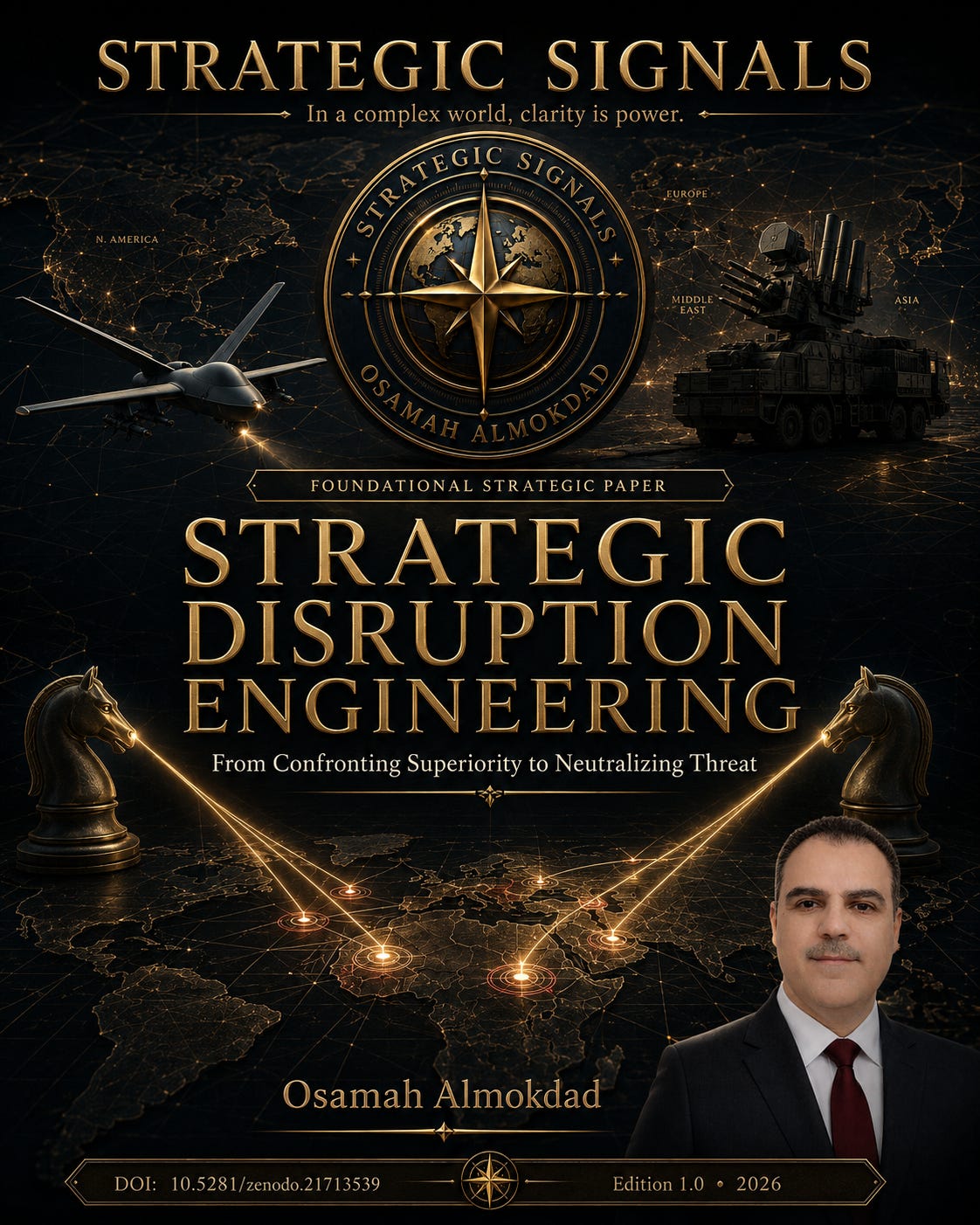
Strategic Disruption Engineering: From Confronting Superiority to Neutralizing Threat
A foundational framework for understanding how superior power can be functionally disrupted, strategically constrained, and neutralized without requiring its physical destruction.

Military and strategic analysis has long been dominated by a deceptively simple assumption: that confronting superior power requires either matching its material scale or destroying a decisive portion of its assets.
That assumption is increasingly inadequate.
Modern power is not merely a collection of platforms, weapons, personnel, or reserves. It is a functioning system whose strategic value depends on its ability to connect capabilities, sustain operations, compensate for losses, regenerate capacity, concentrate force, and convert possession into usable effect.
A materially superior actor may therefore remain powerful in inventory while becoming progressively less capable of producing the strategic outcomes for which that power exists.
Today, I am formally releasing:
Strategic Disruption Engineering: From Confronting Superiority to Neutralizing Threat
This foundational strategic paper proposes a framework for analyzing how the threat posed by a superior power can be neutralized without requiring the destruction of that power or the replication of its material mass.
Full Reference Edition
The complete reference edition of Strategic Disruption Engineering: From Confronting Superiority to Neutralizing Threat is available below as a downloadable PDF.
This edition presents the theory’s full conceptual architecture, analytical framework, methodological foundations, and applied strategic cases.

Beyond Damage
The framework distinguishes between disruption and Strategic Disruption Engineering.
Disruption is an effect that reduces a function’s ability to produce its intended result, delays that result, diverts it, or raises its cost.
Strategic Disruption Engineering is the deliberate design—or analytical discovery—of partial disruptions, followed by their connection, direction, sequencing, and exploitation across:
functions;
links and dependencies;
compensatory pathways;
institutional and operational priorities;
absorption margins;
regenerative capacity;
and the relationship between loss, recovery, and strategic sufficiency.
The central question is not simply:
How much damage was inflicted?
It is:
Can the target system continue producing the minimum functional output required by its strategy?
This distinction changes the unit of strategic analysis. It moves attention away from the nominal value of destroyed assets and toward the system’s remaining ability to generate operational and strategic effect.
Compensation as the Central Variable
One of the paper’s central propositions is that compensation is not merely a recovery mechanism.
Every compensatory response reveals something about the target system:
what it considers indispensable;
where its reserves are located;
which functions depend on one another;
how burdens are transferred;
which margins are being consumed;
and where the next vulnerability may emerge.
Compensation can restore capacity, but it can also create exposure.
It may transfer pressure from one function to another, consume finite reserves, produce congestion, deepen synchronization problems, or turn recovery itself into a source of strategic vulnerability.
The target’s response may therefore become part of the disruption architecture.
From Partial Effect to Strategic Outcome
The paper develops a multilevel model distinguishing among:
execution success;
impact success;
functional disruption;
operational success;
adaptive success;
strategic success;
and collapse-level disruption.
This prevents a common analytical error: treating tactical execution, visible damage, and strategic effect as though they were the same thing.
A successful strike may fail to disrupt a function.
A disrupted function may be rapidly compensated for.
An operational success may produce no durable strategic change.
Conversely, a relatively limited physical action may generate disproportionate strategic consequences when it affects the right function, at the right moment, within a system whose compensatory and regenerative margins are already constrained.
When Strength Becomes Burden
Strategic Disruption Engineering also examines how nominal strength can be inverted into functional burden.
Assets create value only when they can be:
deployed;
protected;
supplied;
integrated;
regenerated;
and employed at the required tempo.
Beyond a certain point, possession may create obligations faster than it creates usable effect.
Recovery may become a deployment trap.
Expansion may exceed absorptive capacity.
Reinforcement may deepen logistical exposure.
A reserve may become a commitment.
Containment may become deferred danger.
In such conditions, the objective is not necessarily to eliminate the opponent’s power. It is to prevent that power from being concentrated, synchronized, regenerated, or converted into strategically sufficient output.
Neutralizing Threat Without Matching Mass
The paper concludes that the threat posed by superior power may be neutralized through one or more of four conditions:
reducing functional output below the threshold required by the opponent’s strategy;
defeating the system’s capacity for sustainable regeneration;
preventing the concentration and employment of force at the time and place of the opponent’s choosing;
or transforming compensation and response into burdens, exposures, and commitments that serve the disruptor’s purpose.
This is not a claim that destruction has become irrelevant.
It is an argument that destruction is only one mechanism among many—and often not the most strategically efficient one.
The deeper objective is to separate power from effect, possession from usability, recovery from resilience, and superiority from strategic sufficiency.
A Testable Strategic Construction
The paper does not claim originality for every component from which the framework is built.
Systems analysis, nodes and links, indirect effects, resilience, operational adaptation, and cost imposition all have established foundations in strategic and military literature.
The proposed contribution is their synthesis into a testable construction that places the dynamic relationship between disruption and compensation at the center of the transition from partial effect to strategic outcome.
Strategic Disruption Engineering is presented not as a closed doctrine, but as a framework for analysis, testing, refinement, and application.
I welcome serious engagement from military professionals, strategists, systems analysts, researchers, and practitioners concerned with how modern power actually produces—or fails to produce—strategic effect.
Publication Details
Author: Osamah Almokdad
Publisher: Strategic Signals
Publication type: Foundational Strategic Paper / Report
Version: 1.0
Publication date: July 31, 2026
Official DOI:https://doi.org/10.5281/zenodo.21713539
The official record includes both the English and Arabic editions.
Arabic Edition
An official Arabic edition of this foundational paper is available under the same permanent DOI record:
Access the Arabic and English editions:https://doi.org/10.5281/zenodo.21713539
Suggested Citation
Almokdad, O. (2026). Strategic Disruption Engineering: From Confronting Superiority to Neutralizing Threat (Version 1.0). Strategic Signals. https://doi.org/10.5281/zenodo.21713539
Professional Correspondence
For professional engagement, research collaboration, media inquiries, or institutional correspondence:
Direct correspondence:
Research and academic engagement:
research@osamahalmokdad.com
Media inquiries and interviews:
I know what you are building and it's outstanding. This piece really put a smile on my face. Well done.